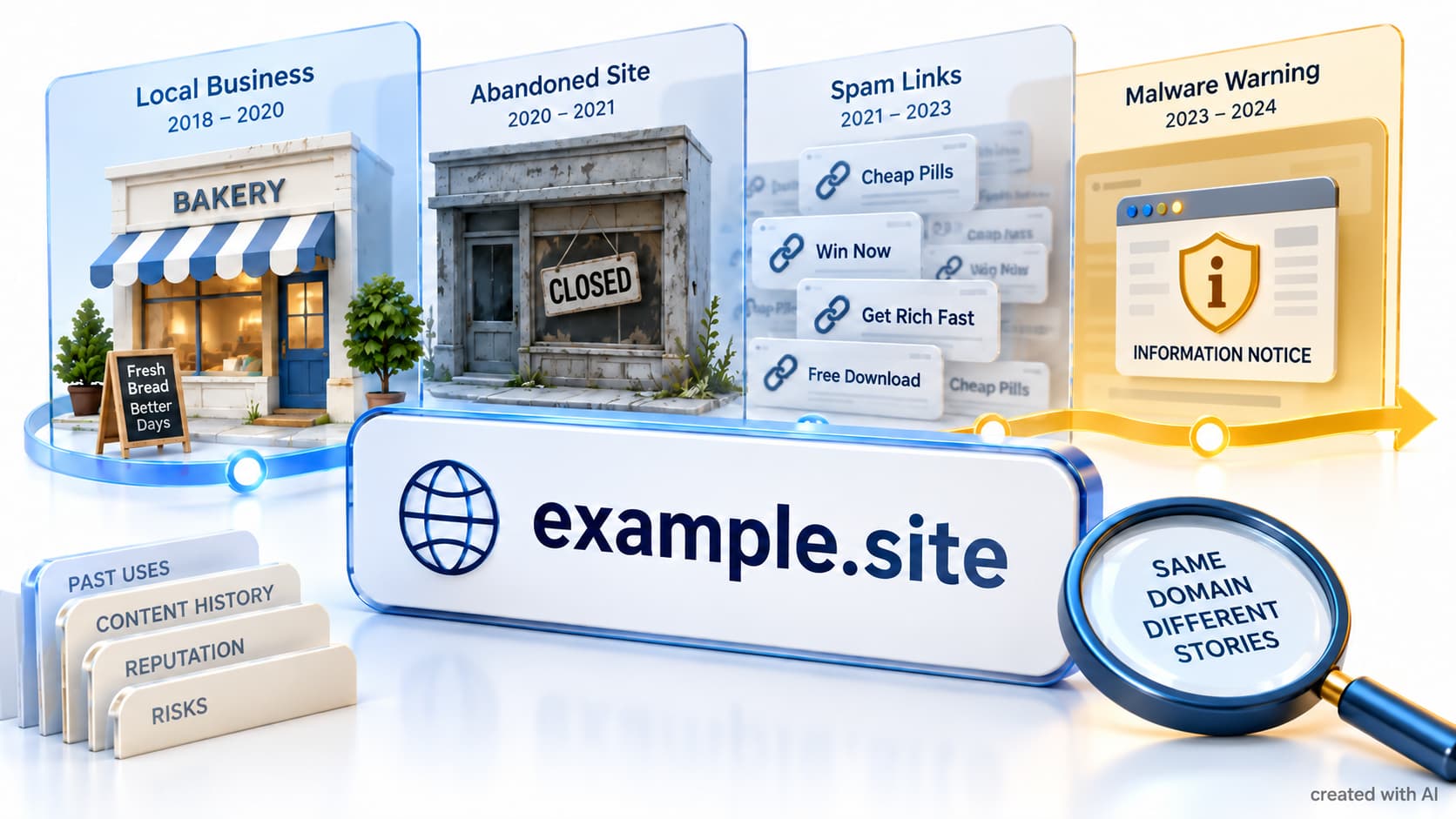
A short, memorable domain may look unused when its current page is blank. That clean appearance says nothing about the previous decade. The address could have hosted a legitimate shop, an abandoned blog, a link farm and a fake download page under four different owners.
Those earlier uses do not disappear when registration changes hands. Search engines, security services and internet users may retain signals connected with the name. A purchase can therefore import problems created for an entirely different business.
Registration Starts a New Contract, Not a New Past
A domain is an address, not a sealed product. Its registration record can change while old pages, links, screenshots, complaints and brand associations remain elsewhere. A buyer receives control of the current registration, but not a guarantee that every external system regards the name as new.
This matters in auctions and expired-domain sales. An attractive phrase or large backlink count may raise the price without revealing whether earlier links were earned or manufactured across disposable sites.
Old Content Leaves Different Kinds of Debt
Previous use can create technical, commercial and legal complications. A history of ordinary ownership changes is rarely alarming by itself. Concern grows when several warning signs point toward deliberate manipulation, deception or a meaning incompatible with the proposed project.
| Historical signal | Possible explanation | Practical risk |
| Sudden change of language or topic | The domain was sold | Irrelevant links and confused visitors |
| Hundreds of keyword-heavy pages | Automated publishing | Low-quality search history |
| Pharmaceutical or download pages | Compromise or spam campaign | Security warnings and distrust |
| Links from unrelated site networks | Aggressive SEO work | Unstable rankings or manual review |
| Name closely matching a protected brand | Coincidence or targeting | Trademark complaint or forced transfer |
No single row produces an automatic verdict. A briefly hacked page differs from years of organised spam. The task is to reconstruct the pattern rather than hunt for one dramatic screenshot.
Backlink Numbers Need Context
A headline total can make an expired domain appear valuable. The useful questions concern where those links sit, what their surrounding pages discuss and why the anchor text exists. Ten editorial references from relevant publications may carry more credible history than thousands of links generated in templates, comments or copied directories.
Patterns deserve attention. Identical anchors, sudden bursts of referring domains, unrelated foreign-language pages and links concentrated on one deleted URL can indicate an artificial campaign. A sharp decline may mean valuable pages vanished years ago, leaving little that a new site can realistically recover.
Archived Pages Reveal the Story
The Wayback Machine allows searches across historical captures of web pages. Reviewing snapshots at intervals can show changes in subject, language, ownership claims, navigation and commercial intent. Important dates include the first available capture, periods immediately before a sale and any sudden expansion in page count.
Archives are evidence, not a complete ledger. Crawlers may miss blocked pages or short-lived campaigns. Missing captures do not prove that a domain was unused. Snapshots become more useful when compared with backlink dates, registration history and security records.
The Name Itself May Carry Conflict
A domain can be technically clean and still be commercially unusable. Names containing an existing brand, a common misspelling or a distinctive product term may invite a trademark dispute. Buying the registration does not grant rights to another party’s mark.
The WIPO Global Brand Database provides access to international and participating national trademark collections. It is a useful screening resource, although it cannot replace legal advice or relevant national searches. Business category and target countries matter alongside an exact match.
A Pre-Purchase Review Needs Several Checks
A disciplined review records evidence before bidding pressure or attachment to a clever name distorts the decision. The investigation should cover both the root domain and important historical subdomains.
- Compare archived snapshots across several years rather than checking only one date.
- Examine backlink sources, anchors, destination pages and the timing of major increases.
- Search the domain in quotation marks alongside terms such as scam, malware and complaint.
- Check current security warnings and ask whether earlier warnings were resolved.
- Review trademark databases in the countries and categories relevant to the project.
- Document unclear periods and set a price reduction or withdrawal condition for each risk.
The checklist should end with a written conclusion: proceed, negotiate or pass. A low purchase price does not repair a name that cannot support the intended brand.
A Good Name Must Survive Its History
Some troubled domains can be rehabilitated through clean ownership, useful content and patient reputation work. Others carry irrelevant links, recurring security flags or legal exposure that outweigh any memorable wording. There is no universal reset button supplied by a registrar.
Domain evaluation should therefore price history as carefully as length, spelling and extension. The strongest purchase is not merely a name that sounds valuable today. It is one whose earlier uses can be understood, explained and safely carried into the next project.